


Tenugui TO TRAIL TO TOWN
Tenugui TO TRAIL TO TOWN
An authentic tenugui dyed using Hamamatsu chusen
- Chusen dyeing: An authentic, vibrantly colored tenugui dyed with the traditional "Hamamatsu chusen" technique.
- PCT design: An original pattern inspired by the Pacific Crest Trail.
- Quick-drying: A specially woven fabric that absorbs moisture and dries fast—the unhemmed edges dry even faster.
同じ送料で他のメール便対応商品もまとめて送れます。
Development story
Development story
Design concept
Design concept
Functional details
Functional details
Size, Spec & Material
Size, Spec & Material
Notes
Notes
About shipping
About shipping
Domestic Shipping
- Methods: Click Post, Yamato Transport, or Sagawa Express
- Fee: Calculated at checkout
- Dispatch: Usually within 2–5 business days of the order
- Tracking: A tracking number is emailed after dispatch
International Shipping
- Method: Japan Post EMS
- We ship internationally to selected regions
- Transit: 7–14 business days


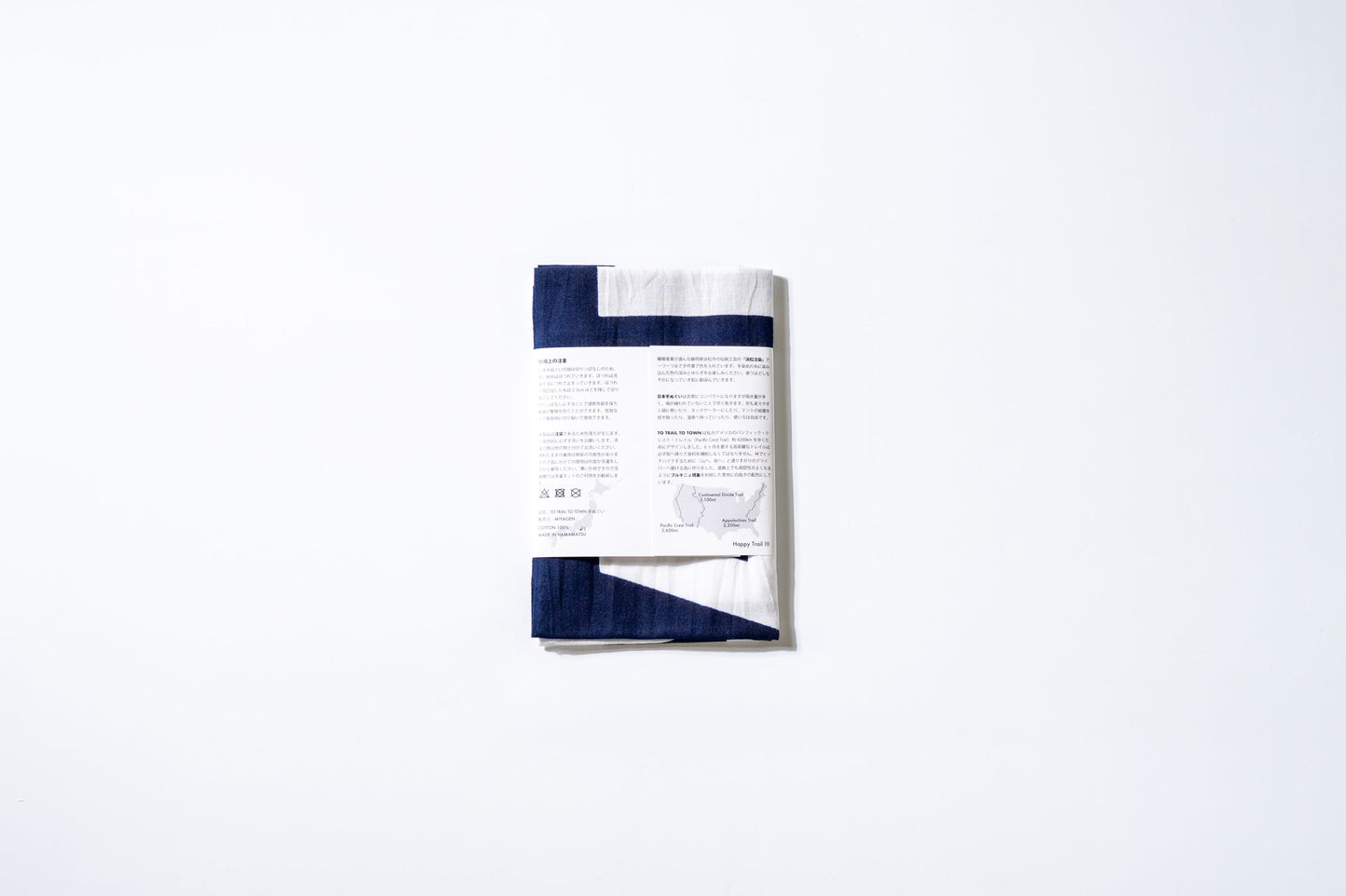

Tenugui TO TRAIL TO TOWN
¥2,200
Development Story / 開発ストーリー
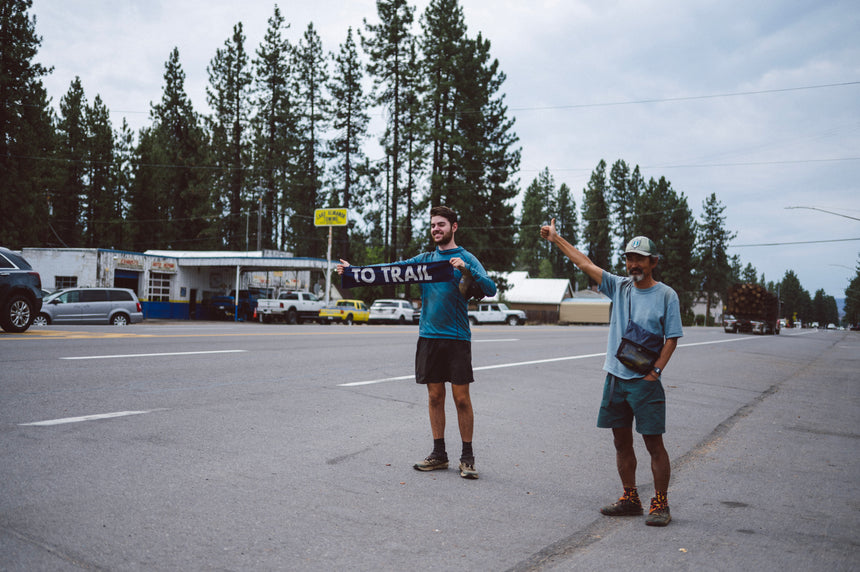
■ Development notes In April I head out on the PCT, a 4,200 km long trail in the U.S. One thing I wanted in my trail kit was something that would help with hitchhiking. I've hitchhiked across Japan, so I know how hard it is and have spent a lot of time trying out little tricks to stand out. Now I'll be doing it in the American wilderness — completely new ground. Travellers often hold up a cardboard sign so drivers notice them, but I wanted a smarter solution that didn't become trash and that had other uses too — and that's when "tenugui" came to mind. Hamamatsu in Shizuoka, where I spent my university years, has weaving as a traditional craft, and the Enshū area is known as one of Japan's three great cotton-weaving regions. I walked into a dyeing studio near my university, and they agreed to make tenugui for us using the traditional Hamamatsu chū-zome dyeing technique.
Design Concept / 設計コンセプト
︎About the design
The design of the tenugui (Japanese hand towel) was created for a long-distance hiking trip to the Pacific Crest Trail in the United States. Hitchhiking is absolutely essential for resupplying fuel and food on long trails. I made this to hold up to passing drivers while hitchhiking on mountain passes, with the message "To the mountains, to the city." Yogi is the origin of my design work. Yogi is a long-distance trail hiker, author of long-distance trail guidebooks, and creator. Yogi's bandana had a hitchhiking message and a PCT map printed on it, making it very informative and useful. However, I wanted to express that in a simpler, more Japanese way, so I tried to translate that idea into the traditional Japanese craft of "tenugui" (hand towel). A characteristic of the Chusen dyeing method is that the dye penetrates to the core of the thread, so the characters will not fade. To improve visibility on roads, the design utilizes the Purkinje effect, employing a blue background with white lettering. Sulfur dyes, like denim, fade with wear and UV light, but the legibility of white lettering remains largely unchanged. In fact, it might even develop a color similar to the blue signs found in Japan. We hope you enjoy the fading process as it absorbs lots of sweat and UV rays. Japanese tenugui towels are very compact, yet highly absorbent, and dry quickly because the edges are not sewn. They are also easy to reshape; you can wrap them around your head, use them as a neck gaiter, wipe away condensation in a tent, or take them to a hot spring. The possibilities are endless. This product has a very simple design, but it has the background described above. A single piece of fabric has been dyed with skillful techniques. Please enjoy the deep colors and subtle variations. It will become softer and more comfortable against your skin with use.
Japanese traditional dyeing technique
Japanese tenugui (hand towel)
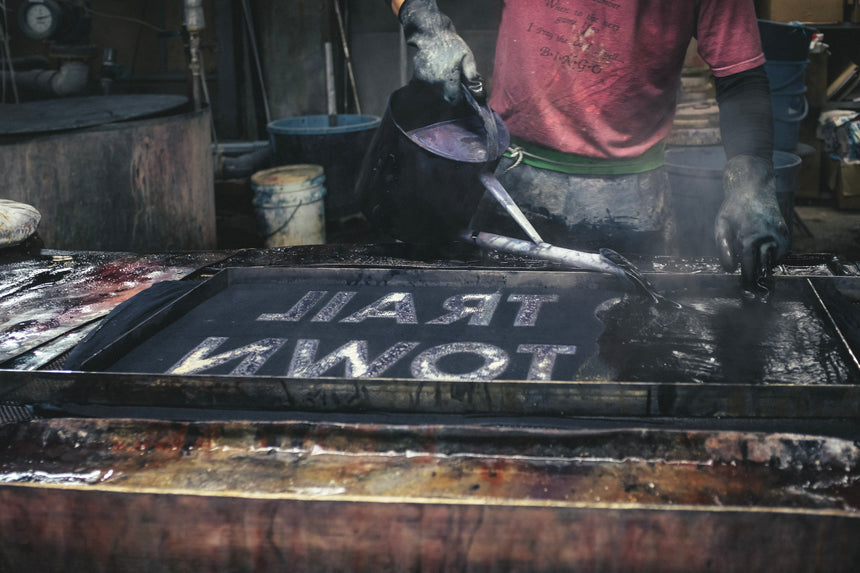
Chusen dyeing dyes the thread all the way to the core, so the characters will never disappear.
White lettering on a blue background is known as the Purkinje effect, and it has good visibility, similar to blue signs.
As the indigo color fades, the contrast decreases, but the color becomes bluer, further enhancing the Purkinje effect.
The edges are not sewn, so it's lightweight and dries quickly.
Function & Detail / 機能ディティール
About the tenugui fabric and dyeing
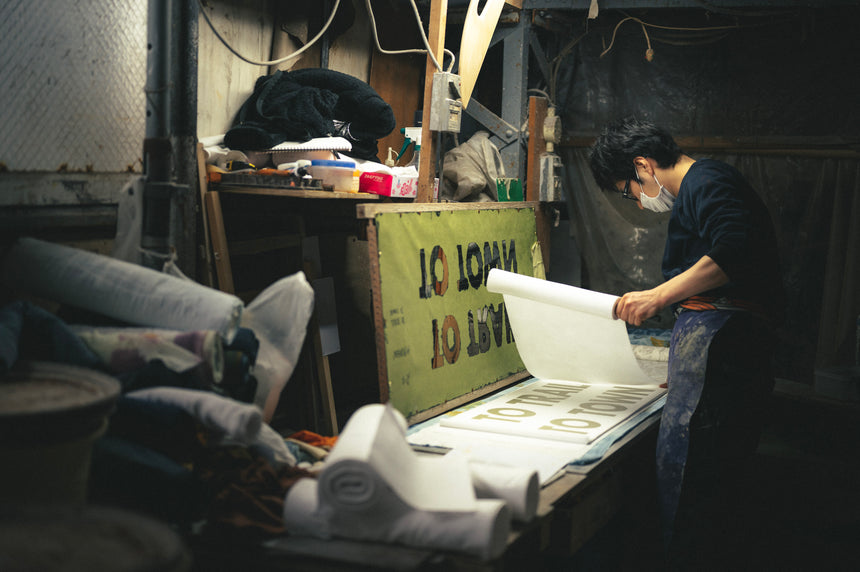
This tenugui uses domestic Japanese fabric woven in Osaka. Among those, we chose Tokuoka — the top-grade cloth, woven with very fine yarns, soft and smooth — so the feel against the skin is gentle. It's thin, with strong absorbency and quick drying, which makes it ideal for the outdoors and for travel. Hamamatsu chū-zome dyeing — stencilling, paste application (paste covers the parts that should not take dye), dyeing, washing, and drying — is done by hand, one piece at a time, by skilled artisans. The colour only really comes out after exposure to water and oxygen, which takes both technique and experience. Chū-zome is a craft only artisans can pull off, and it is the world's only such dyeing technique, found only in Japan. For that reason chū-zome has been designated by the national government as a traditional Japanese craft.
Specs & Materials / スペック・素材
| Product Name | Tenugui — TO TRAIL TO TOWN | |
|---|---|---|
| Product No. | 80010001 | |
| Weight | 35 g | |
| Material | 100% cotton | |
Field Photo / フィールドフォト


Caution / 注意事項
■ Notes about the product Because the edges of Japanese tenugui (hand towels) are left unfinished, they will fray when you first start using them. The fraying will stop as you wash them. Cut off any loose threads, leaving about 2-3 cm. Leaving the edges raw helps maintain quick-drying properties and prevents bacterial growth. It can also be cut open and used in emergencies such as injuries. ■ Precautions for use This product is dyed using the traditional Japanese dyeing method, so color bleeding may occur. Please hand wash before use. When washing, please wash separately from other items. Wearing it while wet may cause color transfer, so please wash it several times before wearing it around your neck. As it is made of thin fabric, we recommend using a laundry net when washing in a washing machine.