

TRAIL ×
ENGINEERING
Strong, light gear takes you farther.
Strong, light gear takes you farther.
As a hiker, I want to reach a little farther down every trail — to feel more of the natural world.
As an engineer, I want to seek out the right materials and structures, and make gear that is strong and light by drawing on what each material does best.
MIYAGEN is a maker that engineers gear for walking far down the trail.

Masaki Miyazaki
Hiker & engineerI test in the field around the world — starting with the 4,265 km Pacific Crest Trail. That experience feeds directly into every piece of gear I design.
Structural engineering, materials engineering, and real experience earned in the field: by bringing the two together, I keep pursuing gear that is both strong and light.
I've walked the Shin'etsu Trail, traversed mountains across Japan, and hiked from the Everest region to the Namib Desert.

Why we build — gear forged on the trail
In 2022, I thru-hiked the Pacific Crest Trail (PCT) — roughly 4,265 km up the U.S. West Coast.
For that trail I field-tested 25 prototypes, breaking them, fixing them, and refining them again and again — in desert heat and in the snows of Washington State. Even after the long trail ended, I kept testing, from the coast of Japan to peaks above 3,000 m, learning what works and what's missing when gear truly matters.
MIYAGEN Trail Engineering shapes only what has been proven on the trail — never specs on paper. That is how we build.

How we think about gear
Lightness and strength are, by nature, a trade-off: make gear lighter and it breaks more easily; make it stronger and it grows heavier. We answer that dilemma with engineering.
We understand how each material behaves, calculate where the forces act, and place the right structure only where it's needed. We cut what isn't necessary and never compromise on what is. The result, we believe, is gear you can keep using on the trail for years.
How we design
MIYAGEN gear begins with failure on the trail. We carry home the frustrations and problems we feel while hiking and build a working prototype — testing how each material behaves, calculating the structure, and prototyping again and again. Then we take it back to the trail and use it until it breaks.
Shipping the finished product is where it really begins.
We never stop improving — driven by customer voices and field testing.
The name "MIYAGEN" — Genjuro Miyazaki, and the spirit we carry on
"MIYAGEN" comes from Miyagen Liquor Store — and from Genjuro Miyazaki, the first-generation owner who founded it.
Around 1930, Genjuro, then a farmer, loaded goods onto a handcart in search of new work and began trading as he traveled. In 1932 he founded the shop that stands today as Miyagen Liquor Store.
As I searched for a name for the outdoor brand, I felt a kinship between Genjuro — who started his trade on the road — and myself, about to take on the trail called the PCT. So I chose to carry his name forward.
In 2022, on the shop's 90th anniversary, I launched MIYAGEN Trail Engineering and began again. A small neighborhood liquor store, losing ground to the big chains, does not survive easily. Yet I believe that carrying on — even in a changed form — is how we protect Miyagen.
In March 2026, the second-generation owner, Yasukazu Miyazaki, passed away at 95. His was a life spent pushing that handcart from behind, watching over the store from the day he was born. His handwriting still lives on in MIYAGEN's products.
Carrying on the will of those before us, we'll keep taking on new challenges — in the way that only MIYAGEN can.
 Miyagen Liquor Store
Genjuro Miyazaki, a farmer in Shiga, begins trading as he travels, pulling a handcart.
Founds Miyagen Liquor Store in Wakamiya, Okazaki, Aichi — an old castle town.
The shop is lost to wartime air raids.
Relocates near the railway crossing by the station.
Moves to its present location.
Launches MIYAGEN Trail Engineering and begins selling outdoor gear. Thru-hikes the PCT (Pacific Crest Trail / approx. 4,265km) up the U.S. West Coast over six months, field-testing 25 prototypes and beginning a way of making gear refined on the trail.
Returns for a second PCT. Hikes through wildfire burn zones and traverses "The Enchantments," a revered range in Washington State — adding further real-world proof.
Opens made-to-order sales of the flagship backpack "CREST 40," realizing its engineering with 3D-CAD three-dimensional patterning and an original carbon X-frame.
Broadens the lineup and tests worldwide. Trials the next model, "CREST 30," in Hokkaido, Kyushu, the Everest region of Nepal, and the Namib Desert of Namibia.
Releases "CREST 30." Major renewal of the online store.

The meaning behind the logo

The M and N of MIYAGEN, joined into one form
The "mi" of Miyagen (ミ)
Switchbacks — the zigzag path up a mountain
Strata of the earth — layers of time carved by nature
A light, strong truss — a symbol of engineering
A spring that works with its material — flexibility and strength as one
ATELIER
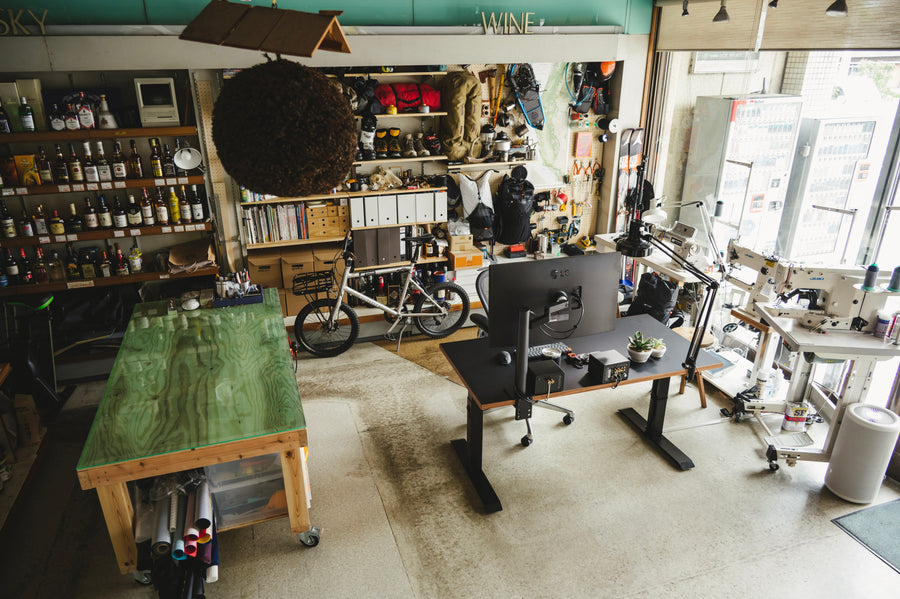
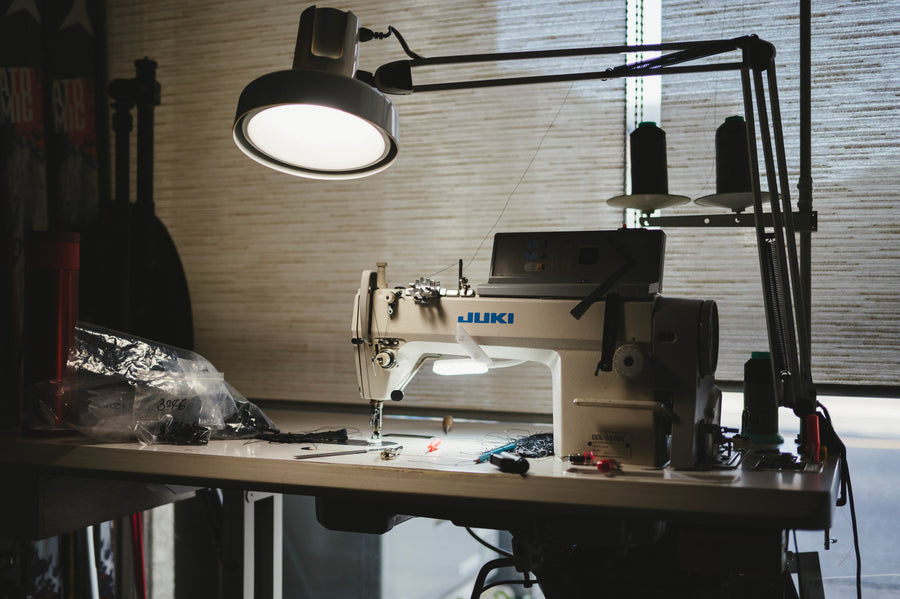
MIYAGEN's atelier sits in a corner of the liquor store in Okazaki, Aichi.
With industrial sewing machines, 3D printers, 3D CAD and a laser cutter, we do everything here — from material testing and prototyping to packing and shipping. Stitch tests on new fabrics, verification, load testing: all the trial and error before a product is born starts in this place.
From time to time we hold an Open Atelier — a chance to see the equipment, handle the materials, or talk MYOG (make-your-own-gear). We announce the dates on Instagram.
* Visits are by appointment only. If you'd like to visit, please book through the reservation page below.
- 所在地
- 愛知県岡崎市 ※営業や予約なしでお越しになるお客様が多いため住所を非公開にさせていただきます。
- ご来店
- ※完全予約制