


Short-Sleeve Merino T-Shirt
Short-Sleeve Merino T-Shirt
100% Super 120s merino wool short-sleeve T-shirt
- High thermal performance: Air trapped between merino fibers delivers excellent insulation—warmth is maintained even when wet.
- Moisture management: The fibers absorb and release moisture, so even when you sweat the fabric stays comfortable and non-clammy.
- Natural antibacterial and odor resistance: Thanks to merino wool's natural properties, odors stay in check even after extended wear.
- UV protection: Merino wool fibers naturally cut UV rays.
同じ送料で他のメール便対応商品もまとめて送れます。
Development story
Development story
Design concept
Design concept
Functional details
Functional details
Size, Spec & Material
Size, Spec & Material
Notes
Notes
About shipping
About shipping
Domestic Shipping
- Methods: Click Post, Yamato Transport, or Sagawa Express
- Fee: Calculated at checkout
- Dispatch: Usually within 2–5 business days of the order
- Tracking: A tracking number is emailed after dispatch
International Shipping
- Method: Japan Post EMS
- We ship internationally to selected regions
- Transit: 7–14 business days


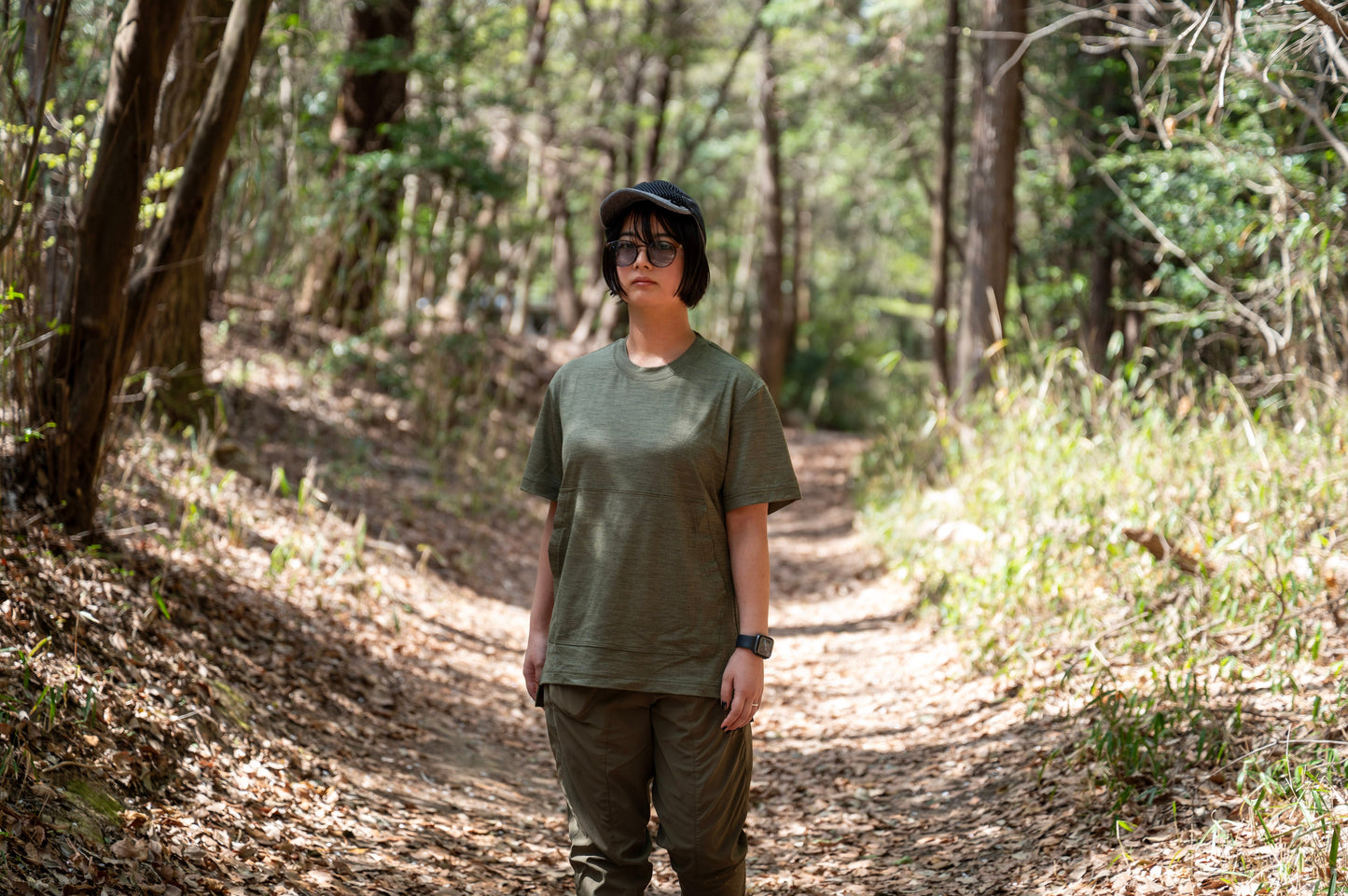

Short-Sleeve Merino T-Shirt
¥19,800
Development Story / 開発ストーリー
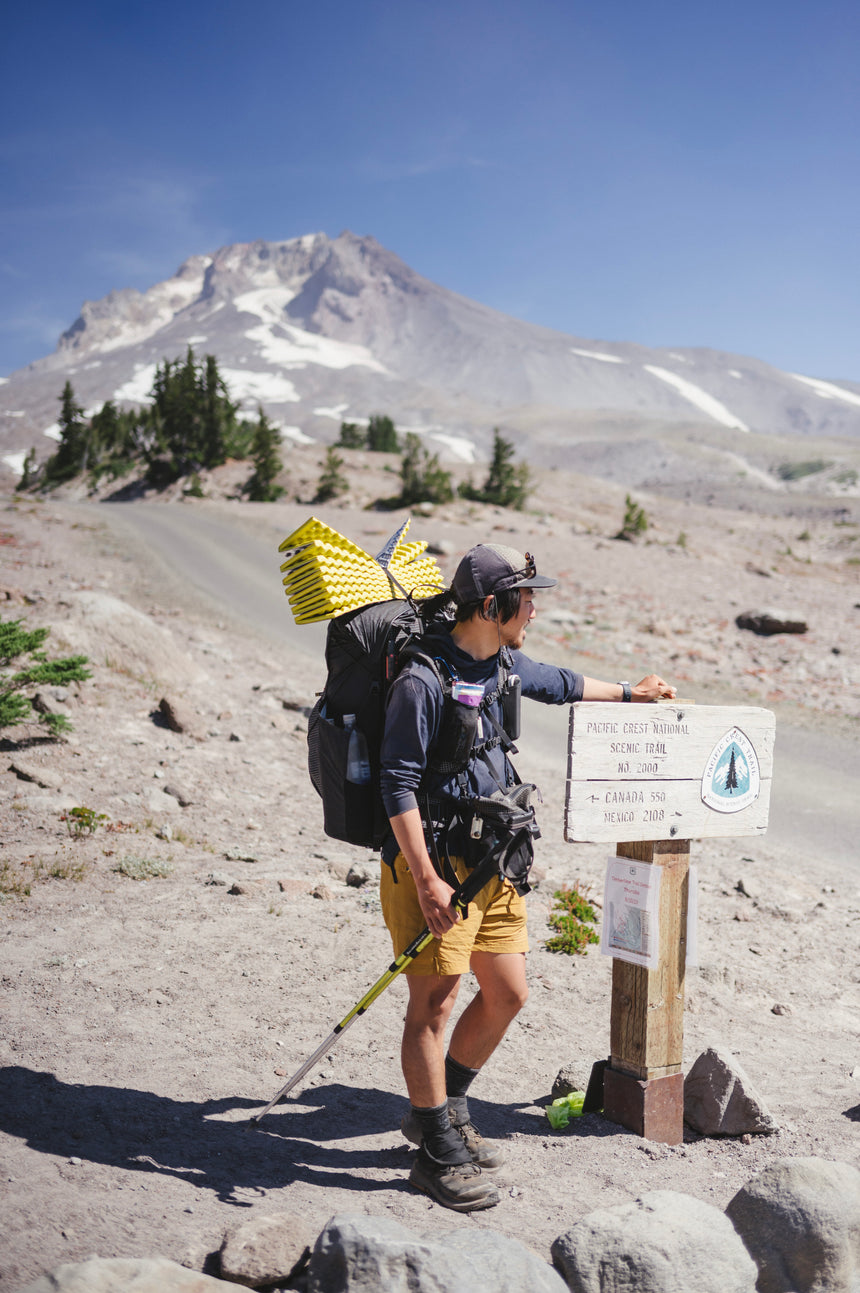
I took a merino T-shirt with me on a long trail just to test it. The fabric was so high-end that I kept asking myself whether it could ever become a commercial product. But out on the trail it really did feel like the right balance of cool and warm — the saying that wool is "an air conditioner you wear" was suddenly true. The wool was soft against the skin, didn't itch, was shrink-treated so I could throw it in the dryer without thinking about it, and held up to the constant rub of the backpack without tearing. I fell for the fabric. Long sleeves are great for blocking the sun, but in summer especially I wanted a T-shirt that breathes well, something I could grab for a casual day hike — so I made a T-shirt model. — What I felt walking 4,200 km on the PCT — Wool has wonderful benefits, but it also has downsides. At MIYAGEN we worked through how to address those downsides. During development we asked ourselves what to prioritise, whether to insist on 100% wool, or whether to bring in the strengths of synthetic fibres. First, we re-evaluated the merits and demerits in our fabric selection. The merits of wool: - High warmth retention - Hygroscopic, so it's comfortable to wear - Antibacterial and odour-controlling - Good UV protection The demerits of wool: - Can feel itchy - Tends to shrink (felting) - Wears down easily; durability is a challenge - Vulnerable to damage from insects - Slow to dry Wool production has constraints, and those constraints push the cost up. Among an already constrained category, the wool fabric we further selected is so expensive that during development we genuinely struggled with whether or not to sell it. But after walking 4,200 km on the Pacific Crest Trail, from desert to glacier, the way it felt against the skin was wonderful, and that experience reaffirmed how complete this wool fabric really is. The selling price will be high, but to bring that comfortable wear, the versatility that performs in any condition, and the appeal of wool itself to as many people as possible, we decided to put it on sale.
Design Concept / 設計コンセプト
Merino wool fibre certified by an independent third party. We selected fabric from an Italian mill with more than 100 years of history. Through automation and dedicated research facilities, the mill produces uniform, high-quality wool fabric with excellent performance — one of the top names in the wool-fabric world. They run the entire chain themselves, from sourcing raw wool at their own farm in New Zealand through spinning and weaving, with rigorous management of the raw wool and full transparency about where it comes from. They actively pursue environmental initiatives — breaking down dyes and returning them to nature, running their plants on solar energy, and similar production practices — and have built that into their system. They have received many certifications from third-party bodies focused on environmental stewardship, and they actively pursue SDGs goals. The wool used by MIYAGEN Trail Engineering is from "Super 120" — a particularly fine yarn even within merino — selected for its long-staple fibre, which means very little pilling. It is so soft and so free of itchiness that it doesn't feel like wool.
A fibre that evolved to live: wool that repels water yet absorbs water Wool has a cuticle (also called scales). The cuticle is hydrophobic, while the cortex (the protein structure underneath it) is hydrophilic. The hydrophobic cuticle covers the hydrophilic cortex, giving wool a uniquely layered structure. This layered structure is wool's biggest characteristic. In addition, a thin layer of air is held between fibres on the hydrophobic surface of the cuticle, which lowers thermal conductivity and helps retain body heat. Because of the cuticle, wool offers a list of features no other fibre has:
Repels water yet can absorb water
Stays warm even when it has absorbed water; the fibre "breathes"
Resists soiling
Excellent flame and fire resistance
Hard to break, with strong elasticity
Shape memory
Easy to spin into yarn
Quoted from The Woolmark Company (https://www.woolmark.jp/fibre/).
A special multi-stage shrink-resist treatment that preserves the cuticle The cuticle and scales have another important property: "felting performance." When wool absorbs moisture, the scales open and the surrounding wool fibres tangle more easily, so felting progresses. The reason a sweater shrinks in the wash is exactly this opening of the scales. The back panel of a backpack also has all the conditions for felting to progress, which can be a real problem in the outdoors. Wool is normally treated to resist shrinkage, but if too much of the scales is removed, the fabric becomes too hydrophilic and loses some of wool's native characteristics. Resin-coating approaches, on the other hand, halve the very benefits that make wool wool. For MIYAGEN's wool products, we apply a multi-stage shrink-resist treatment across cotton, yarn, and fabric stages. This special multi-stage treatment lets us bring out wool's strengths — moisture-wicking, breathability, warmth retention, antibacterial and odour-control — to the fullest. It also produces a fabric that doesn't shrink or pill easily even on the back of a backpack, with very high abrasion durability. Because of this treatment, the fabric also handles standard household electric or gas dryers after washing.
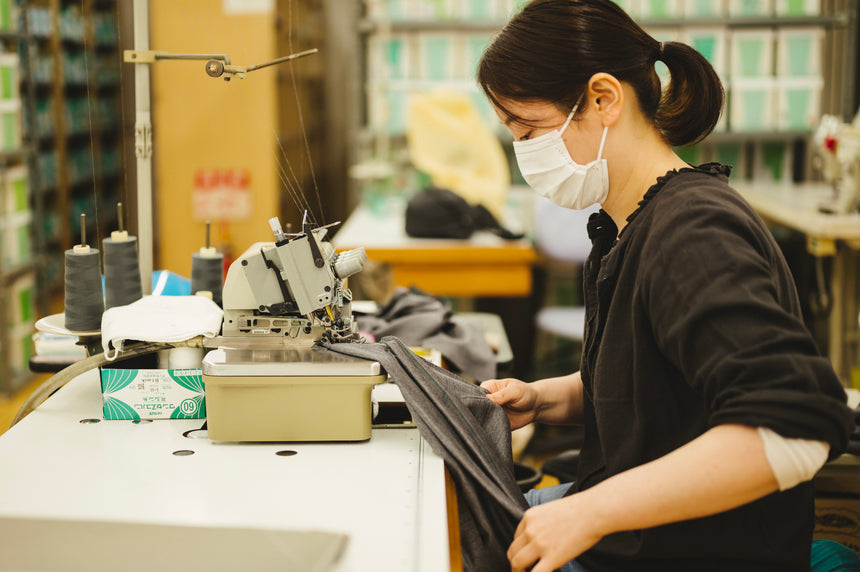
This product is fully made at sewing factories in Japan. Pattern making, cutting, sewing, and finishing all happen at our partner factory in Okazaki, Aichi. A skilled patternmaker developed the three-dimensional pattern; many samples were made before we reached the version we now sell. Being a small brand we order in small lots, but the factory said: "If a brand like yours is starting in Okazaki, we want to help you make it." It's been a pleasure to visit them many times and watch carefully made garments come together. They told us that, because this jersey-knit fabric stretches, it requires very high skill to sew — and because the fabric is very expensive, they're especially careful with cutting and stitching. Aichi was once a thriving textile region. Toyota, Aisin, and Brother produced looms and sewing machines, and the area grew from textiles into automobiles and aerospace. As labour costs rose, the textile industry contracted and most of it moved overseas. Sewing is always done by human hands; clothes that are fully sewn by robots barely exist. As labour costs go up and overseas products take more share, we have deep respect for the textile industry and its skill — the industry that supported Japan's development. It's a real piece of luck that we found this factory.
Function & Detail / 機能ディティール
Designed for long trails A design that is easy to use for a long time.
Main body
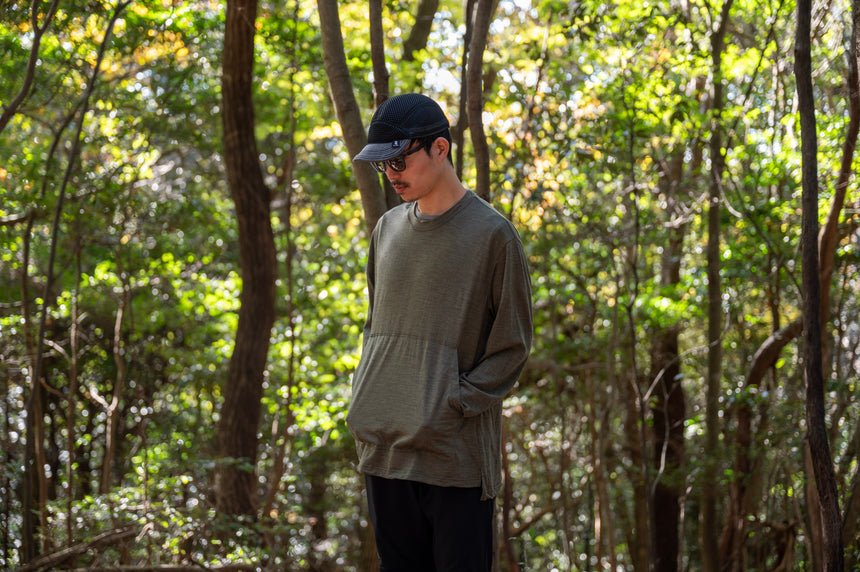
We've made it slightly oversized to allow for easier movement in the field. We focused on creating a pattern that can be worn not only for hiking but also for everyday wear. We use simple stitching to reduce the number of threads and minimize any feeling of tightness. Although it's a simple pattern, it's designed using three-dimensional cutting, with a larger back and a smaller front. Furthermore, the back is made longer to prevent it from riding up when bending or squatting. The photo below shows the long-sleeved model.
Kangaroo pocket
Kangaroo pockets have long been used to prevent hands from getting cold, and are also known as muff pockets or hand warmer pockets. Furthermore, the placement of the pockets is also important. The abdomen is one of the warmest parts of the body, making it the ideal place to warm your hands. You can also keep your stomach warm by putting a towel or a hand warmer in the kangaroo pocket. Furthermore, you can use your body heat to make cold meals (hiking meals that don't require gas). You can use it however you like: put a water bottle in your pocket to carry to a water source that's a bit far away, or use the water bottle to cool yourself down...the possibilities are endless. While some companies might cut costs by using a different fabric for the pockets, we prioritized warmth and insisted on using wool for all parts.
Specs & Materials / スペック・素材
| Product Name | Short Sleeve Merino T-Shirt | |
|---|---|---|
| Product No. | 12020004 | |
| Weight | 280 g | |
| Material | Jersey-knit, 100% merino wool (195 g/m²) | |
| Size | S, M, L, XL (unisex) | |
| Made in | Aichi, Japan | |
Field Photo / フィールドフォト


Caution / 注意事項
Product maintenance and storage You can extend the lifespan of your product by doing the following: About laundry - Please use a laundry net when washing. - When first used, it may have a characteristic animal-like smell of wool. Merino wool has odor-eliminating and antibacterial properties, so it doesn't need to be washed frequently. However, if sweat and oil accumulate, sand and dirt will build up, which will accelerate wear and tear and cause significant damage to the fibers. Please wash after activities. - If using a washing machine, place the item in a laundry net and wash it on a delicate cycle. About detergents - Please wash using a neutral detergent. - If heavily soiled, please wash with a mild alkaline detergent or oxygen-based bleach. - Never use chlorine bleach, as it will dissolve wool. - Do not dry clean. About dryness - The dyes used in the wool will fade due to ultraviolet light. Please dry it in a shady, well-ventilated place. - Using a hanger will help clothes dry with fewer wrinkles. - Iron at a low temperature (around 60 degrees Celsius). Regarding the use of a washer-dryer (electric or gas) - Although the care label has a "do not tumble dry" symbol, it can be safely put in a dryer. - When using a dryer, a low temperature setting (60°C or below) is ideal. However, if temperature control is not possible, put it in the dryer as is. *The entire garment will shrink by a few percent after the first wash. *The garment will shrink by about 1-2 cm in the dryer, but it will return to its original size due to body heat and humidity when worn. Regarding storage - Since wool is a protein, it may be eaten by pests that are attracted to wool. Please store it while taking measures to protect it from insects, such as using insect repellents sold at pharmacies. - Avoid ultraviolet rays. Regarding size exchanges If the product size is incorrect after purchase, we will exchange it for you. - We will only exchange unused items; however, minor use such as trying them on is acceptable. - Exchanges are only accepted within 7 days of product arrival. - We may refuse returns if we find any odors such as tobacco or perfume, stains, or cosmetics on the product after inspecting it. Please be careful when trying on the product. Regarding repairs Merino wool is animal hair and is composed of protein. Special shrink-resistant processing enhances comfort, but it also has weaknesses, such as being susceptible to moth damage and abrasion that can cause holes. Particular attention should be paid to insect damage. If a hole appears, you can repair it yourself by felting it. However, the wool fibers in this product have been treated to prevent shrinkage, making felting difficult. Customers can purchase yarn from a craft store and use a felting needle to felt the wool fabric together for self-repair.