


LW Separate Dry Socks – Tabi, Short Length
LW Separate Dry Socks – Tabi, Short Length
Separate construction reduces friction and moisture between the toes
- Separate construction: Reduces friction between toes and absorbs interdigital sweat—effective at preventing blisters and moisture buildup.
- Manila hemp paper yarn: Delivers a connected, barefoot-like feel against the ground with natural antibacterial and odor-resisting properties.
- Cordura nylon: High abrasion resistance for long-term durability.
- Merino wool: Combines moisture management and warmth for year-round comfort.
- Short length: Lightweight and compact—ideal for warm seasons or low-altitude hikes.
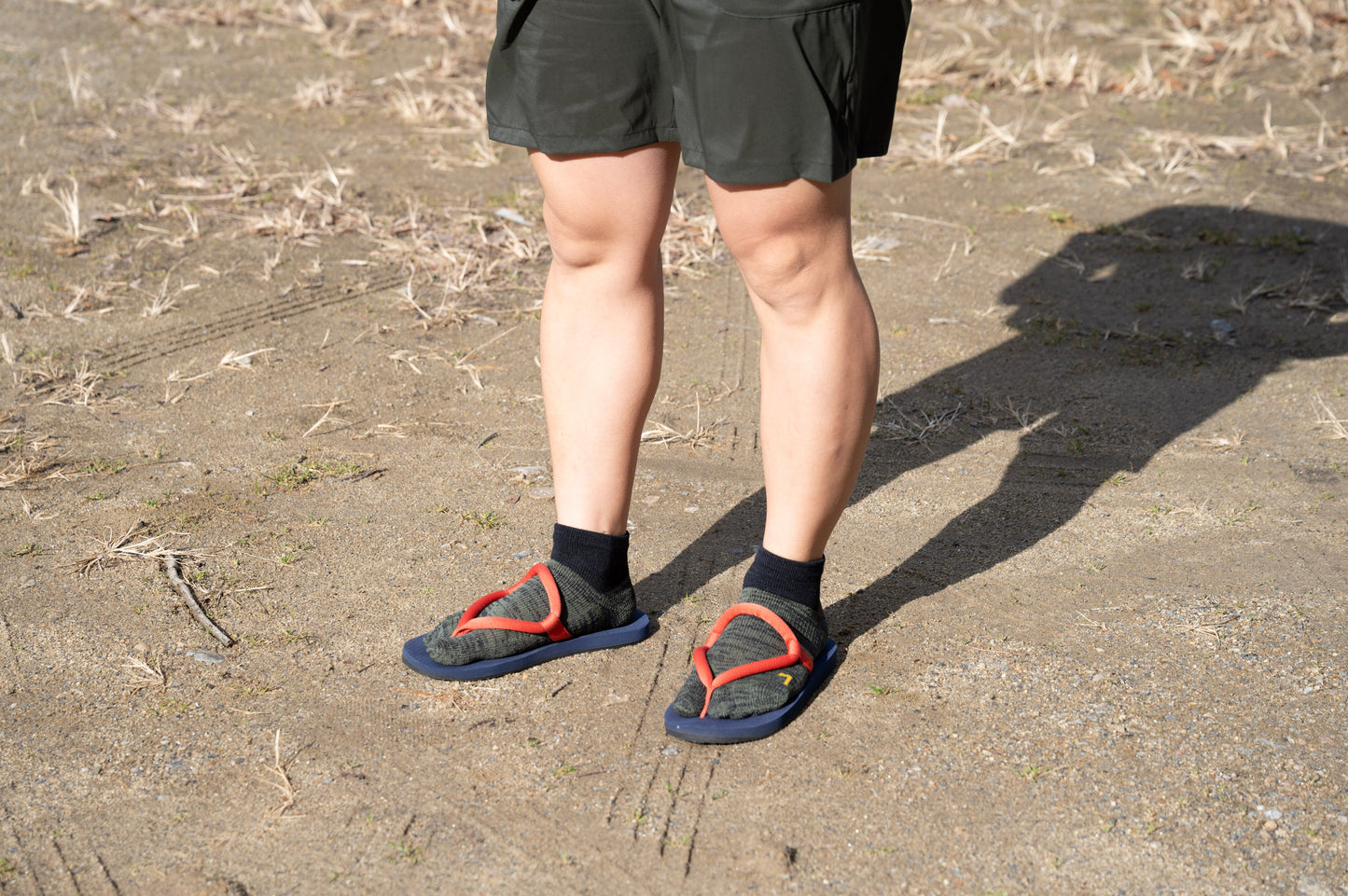
- Tabi style: Lets you push off with the big toe for a runner's stride; works great with sandals too.
1点でのご注文時の送料です。ご注文の合計が240g以上になると宅急便(¥800)になります。
Development story
Development story
Design concept
Design concept
Functional details
Functional details
Size, Spec & Material
Size, Spec & Material
Notes
Notes
About shipping
About shipping
Domestic Shipping
- Methods: Click Post, Yamato Transport, or Sagawa Express
- Fee: Calculated at checkout
- Dispatch: Usually within 2–5 business days of the order
- Tracking: A tracking number is emailed after dispatch
International Shipping
- Method: Japan Post EMS
- We ship internationally to selected regions
- Transit: 7–14 business days




LW Separate Dry Socks – Tabi, Short Length
¥3,740
Development Story / 開発ストーリー
■ Development notes Among our customers, the most requested style was the tabi (split-toe) shape. A separate-toe construction in which only the big toe is split off looks to be a first of its kind, so we worked through the knitting pattern with the factory by trial and error. While developing the existing round separate sock, we also worked on a tabi version to meet that demand. The separate-toe construction reduces friction between the toes and disperses sweat efficiently, lowering the risk of blisters. While preserving those benefits, separating the big toe makes it easier to push off — a clear advantage in active settings like running and hiking. The yarns are the same as on the existing model, so cushioning and dryness around the ankle are unchanged. Field tests confirmed that even when you keep these on as inner socks, take off the outer socks at camp, and let everything dry, these dry well even while still being worn. (If they get wet, e.g. from rain, we recommend taking them off.) In early prototypes the big-toe section was short, but tests showed that making the big toe a bit longer reduced load on the base of the toe and improved the thinness of the toe tip, so we reflected that in the current spec. For the upcoming season — and for users who mostly wear sandals but still want socks — give them a try. • Improvement We used to print L/R marks; we have removed those, and from this version we print the size instead.

Design Concept / 設計コンセプト
Design
The defining feature of these socks is a divider between the toes that prevents the blisters that form between adjacent toes.
In a typical five-toe sock, two layers of fabric overlap between each toe — that widens the foot and tends to cause blisters and fatigue. The separate construction we adopted reduces the fabric between the toes to a single layer, giving you a "hidden five-toe" sock that doesn't feel strange to wear. The divider stops toes from rubbing or stepping on each other, and sweat is wicked away through the divider. Production efficiency is lower, but we use Wholegarment knitting technology, which can knit truly three-dimensional shapes. There is also arch support to keep the sock from sliding around.
In a tabi-style sock, there are roughly two ways to split off the big toe, and the way you split it changes the feel. The sock-knitting-machine method knits a wide, soft surface — almost like a hammock — which gives a comfortable fit at the base of the toes when you put the sock on. Wholegarment, on the other hand, allows complex one-piece designs with a clear separation between toes, giving a sharper, more unified look. The downside is that a "valley" forms at the big toe, and that valley can hurt the foot. We iterated through prototypes to design that out.

親指だけ独立したタビ構造。サンダルにも対応。親指だけ独立しているので走るのにも踏み込みがしやすい構造。

指の間に仕切りを設けることで、擦れや水膨れを軽減するセパレート構造です。 一般的な5本指ソックスのように生地が重ならないため足幅が広がりにくく、自然な履き心地を実現。仕切りが汗を吸収・拡散します。

ショート丈はスニーカーから1-2cm長く、クルー丈はくるぶしから5cmの高さに設定しています。


Function & Detail / 機能ディティール
Eco-friendly Manila hemp
Manila hemp is a perennial in the same family as the banana plant — even the leaves look similar. It grows on a roughly three-year cycle, so the burden on the environment is light and the resource is sustainable. The fibre is full of tiny pores, which gives it excellent moisture-wicking, fast-drying, and odour-control performance.
Production technology and comfort
We use a slit technology unique to Japan to process the Manila-hemp fibre into a washi-like sheet without losing the fibre itself, then spin it into yarn. This very fine slit processing can only be done at a handful of factories, and the details of the process are an industry secret. As a result, the unique crisp texture and smooth hand feel of this yarn is a precious technology that cannot be reproduced anywhere else. We also twist the Manila-hemp yarn together with polyester filament to raise both strength and comfort. On top of that, weaving Cordura nylon into the construction makes the sock able to stand up to demanding environments.
Why feet get uncomfortable
Before humans evolved, our bodies were covered in hair, and the main areas of perspiration were the hands and feet. Sweat is produced on the hands and feet to add friction, and the foot is said to produce around 200 ml of sweat per day. This sweat causes blisters, which in turn cause injuries.
Manila-hemp washi yarn
Protect the foot from moisture and friction On long trails and trail runs, blisters caused by moisture (mainly sweat) and friction are very common, and they can lead to injuries. While walking the PCT myself, I personally saw a hiker hospitalised because of blisters. On long-distance walks, blisters become a serious problem.
What sets Manila-hemp paper yarn apart
There are roughly two kinds of paper yarn: wood-derived and grass-derived. Of the yarns we tested, the grass-derived Manila-hemp paper yarn was clearly the best. The yarn is extremely tough, has a crisp, refreshing feel, and sits well against the body. Manila hemp is one of the strongest plant fibres, with very high resistance to weather and wear — it's used in elevator cores, marine ropes, premium envelopes, and even banknote paper. The paper yarn is so strong, however, that we found it too hard against the skin around the ankle of the shoe. So at the ankle we combine it with wool and nylon for a softer, more comfortable feel.
How to wear these socks so they last
These socks have dividers, so it's important to put your toes in the right places. Be careful not to mix up the toes when you put them on. When you're on a long trail, regular washing — to avoid mud and sand building up in the socks — is the trick to making them last.

マニラ麻繊維由来の紙糸を使用したシャリシャリとした水はけのいいドライ素材を使用

特殊なスリット技術を活用しています。この極細スリット加工は日本で一つの工場でしか実現できない貴重な技術を使用しています。

主となる発汗部位の手足は摩擦を付与するために汗が出ており、1日200mlと言われています。 この汗が水膨れの原因となり、怪我の原因となってしまいます。それを防ぐために吸湿性の高いままドライ感の続くマニラ麻紙糸を使用しています。


Specs & Materials / スペック・素材
| Product Name | LW Separate Dry Socks — Tabi, short length | |
|---|---|---|
| Product No. | 16020002 | |
| Weight | — | |
| Material | Cordura nylon, Manila-hemp paper yarn, merino wool, polyester, PU | |
| Size | S 22–23.5, M 24–25.5, L 26–28 (cm) | |
| Made in | Aichi, Japan | |
Field Photo / フィールドフォト


Caution / 注意事項
■ Notes about the product Fabrics and designs are subject to change without notice. The fabric shown in the photo may be discontinued without notice and become unavailable for purchase. Please make sure to trim and shape your toenails before wearing the socks. Long toenails will drastically shorten the lifespan of the socks and can cause them to tear. ■ Precautions for use This part has been field-tested, but we cannot guarantee that it will not break. Please use this product at your own risk and take care not to place excessive load on it. The manufacturer shall not be held liable for any damages incurred as a result of using the product.