


CREST 40
CREST 40
A 40L UL backpack for long trails—about 1,000g
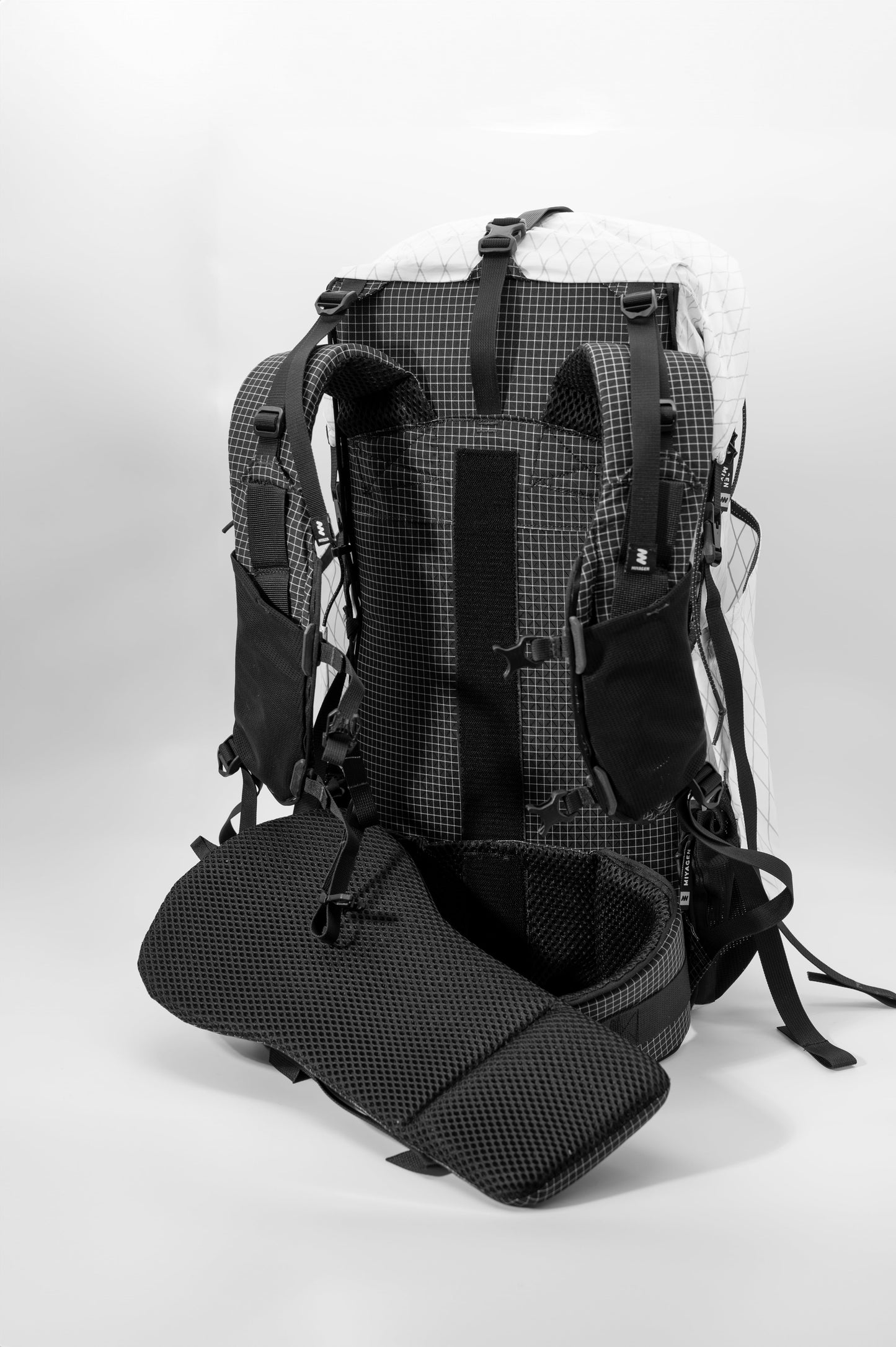
- Load distribution: A 3D-CAD frame derived from human anatomy works in tandem with the back panel and belts to distribute load across the entire body.
- Three-foam shoulder harness: Layered foams in three densities mold to the body's curves.
- MIYAGEN original fabrics: Different fabrics in different zones reinforce high-stress areas.
- Full-perimeter daisy chain: Plenty of room for hikers to extend or fine-tune in the field.
- Made in Okazaki, Aichi: Made in Japan—planning, design, cutting, and sales handled in-house at our own workshop.
同じ送料で他の宅急便対応商品もまとめて送れます。
Development story
Development story
Design concept
Design concept
Functional details
Functional details
Size, Spec & Material
Size, Spec & Material
Notes
Notes
About shipping
About shipping
Domestic Shipping
- Methods: Click Post, Yamato Transport, or Sagawa Express
- Fee: Calculated at checkout
- Dispatch: Usually within 2–5 business days of the order
- Tracking: A tracking number is emailed after dispatch
International Shipping
- Method: Japan Post EMS
- We ship internationally to selected regions
- Transit: 7–14 business days



CREST 40
¥66,000
Development Story / 開発ストーリー
■ Development Notes When I decided to start MIYAGEN, this backpack was the first thing I created. To keep the liquor store "Miyagen" going. To hike the PCT. To continue as an outdoor equipment manufacturer. This backpack for long-distance trails/traverses was created as a first step, born from a combination of several factors. For long-distance trails where resupply is necessary, a backpack of around 30-40 liters is now considered standard. 30L is a world for ultralight hikers who have mastered the art of selecting and prioritizing their gear. It's about packing with a base weight of 3-4kg and carrying nothing unnecessary. I feel it's a realm only achievable by those with both the physical strength and experience to succeed. On the other hand, for many people, the start of a long trail run begins with a state where "the body and senses are not yet in peak condition." The amount of food, warm clothing, rain gear, extra money for emergencies, and sometimes a camera or personal items—there are always things you can't cut back on. Given that reality, I concluded that a capacity with a 40L "safety margin" was necessary, rather than trying to cram it all into 30L. I believe that major manufacturers of backpacks have a history of prioritizing the "carrying structure" above all else, striving to make the load feel lighter. Despite its older design, the high level of craftsmanship is evident in the surprising and innovative ideas it incorporates. However, as a company grows, the emphasis on long-term durability can sometimes lead to areas where the product becomes "excessive" for some users. Therefore, I wanted to achieve a balance between maintaining the essential requirements of ultralight gear, incorporating an engineered mechanism, a comfortable carrying structure, and durable materials that would allow the manufacturer to be successful, all within the same product line. The load-bearing mechanism is designed as a whole, including the frame, rather than relying solely on belts and pads. We anticipate changes in load during walking, fine-tune the balance between shape and rigidity, and make updates while verifying them on-site. Rather than focusing on the feeling of comfort the moment you put it on, we aimed for a design that provides relief after walking all day. The CREST 40 is not a backpack that will surprise you with flashy gimmicks. It's surprisingly easy to use. It's comfortable to carry. By reducing the swaying and deviations with each step, fatigue and judgment errors are reduced, ultimately leading to greater distance. This is a tool that embodies MIYAGEN's vision of "Trail Engineering" in a quintessential, classic backpack. Incidentally, for the first PCT, the design incorporated a frame into the Ray Jardine backpack, while for the second PCT, it evolved into its current bulging shape, with the center of gravity positioned higher up on the body.
Design Concept / 設計コンセプト
Design Notes|CREST 40
• Overall design: Starting with the "structure" of how it's carried on the back. The CREST 40 is designed not to rely solely on the feel of the belts and padding to create "ease of carrying." The goal was to prevent the load from shifting unintentionally up, down, left, or right while walking. When the load sways, fatigue increases, your form breaks down, and you can no longer enjoy nature. I think a waist belt makes things easier when the weight is around 10kg. The shoulder straps should be positioned so that the weight is distributed as much as possible to the chest. To minimize overall swaying, we first determined where the load would pass through the body and designed the frame accordingly. The frames and sewing patterns are all designed using 3D CAD, based on the human body, to create three-dimensional patterns. Pattern design: Simple appearance with three-dimensional cutting The design employs an inverted triangle pattern to keep the center of gravity higher. Even when packed, the center of gravity naturally shifts upward, resulting in greater stability while walking. Packing is Sleeping bag at the bottom, cookware, extra clothes, and tent equipment in the middle, and food on top. This design is based on the "reality of being in action," ensuring ease of use and stability. Furthermore, it's designed to perfectly fit the Luminana Sack 10L. • Frame: Retains lightness and "necessary flexibility" If the frame is designed solely for lightness, it becomes too soft, resulting in a delay in load transfer. Conversely, if it's too stiff, it won't follow the body's movements, leading to localized pressure points. CREST 40 was designed with a focus on the balance between shape and rigidity, taking into account the changes in load during walking. Rather than the initial feeling of comfort when putting it on, I prioritize the feeling of "it hasn't shifted," "it doesn't hurt," and "it doesn't sway" after walking for several hours. The frame then distributes the load across the entire body. This frame is constructed from 3D printed materials and carbon fiber, and its design is the result of repeated destruction by hikers and mountain guides. Shoulders and waist: Moderate firmness and softness I believe that a good fit cannot be achieved by improving only the back, only the shoulders, or only the waist. Because the way the load is distributed is determined by the coordinated action of three points, CREST 40 is designed to be "worn with the whole body." To prevent it from breaking down due to differences in body size or seasonal layering, the design distributes pressure and leaves room for adjustment. The shoulder harness uses a combination of three types of sponge to create a structure that absorbs the contours of each individual's body. This is a costly part, but we didn't compromise here. It's a shame that it's not visible, but it's where the compatibility with the frame is most important. Additionally, a gap is intentionally created between the back of the shoulder and the shoulder harness. While it's generally thought that having no gap is better, we believe that a design without a gap makes it difficult to raise the shoulders, leading to fatigue. The "shoulder gap" is a necessary margin, as it allows the load to be transferred through the frame to the chest. • Side pockets: Prioritizing ease of movement during activities. The stress of long-distance trails increases with the number of times you stop and the time you spend searching for things. Therefore, when it comes to storage, we prioritized "speed of access" over capacity. The side pockets are designed to be large enough to hold a 2L plastic bottle. On long trails, I often pack my tent last, so I needed a bag with enough capacity to accommodate it. We also considered ease of access, designing it to be easy to open and close if your hand can reach the edge. • Expandability: A design that is not "complete" with a daisy chain all around. Long-distance trails often require the user's ingenuity to find the optimal solution. Therefore, the CREST 40 features daisy chains all around, leaving room for fixing, expanding, and external attachments. Rather than the manufacturer dictating how it should be used, the design allows hikers to optimize it in the field. Furthermore, we consider the ability to change the configuration according to the situation, rather than always being "fully equipped," to be a key aspect of performance. On days when you're lightly dressed, on windy days, on rainy days, or on days when your pack is heavy after resupplying, the requirements for the same 40L pack change. We plan to expand our module lineup in the future. • Materials: Differentiate between lightness and durability for different uses. Durability is important, but making everything excessively durable results in unnecessary weight. CREST 40 uses different materials depending on the function, such as areas prone to damage, areas where weight is concentrated, and areas that are subject to friction. It's not about being "strong in everything," but rather "strong where it's needed." Furthermore, all fabrics other than X-PAC are custom-made by fabric manufacturers specifically for MIYAGEN. • Mass production capability: The "reproducibility" required for a manufacturer to be viable. Since MIYAGEN products are intended as tools, they must offer reproducibility and quality. We incorporate design considerations to address processes prone to individual variations, ensuring stable sewing and assembly. We believe that avoiding creating "difficult-to-manufacture shapes" solely for the sake of lightness is also part of the design process. Regarding the cutting process, I built my own laser cutting machine to ensure a cut that is less prone to fraying. • Designed in the field It is subjected to weight-bearing walking, continuous use, and unexpected treatment. We envision updating the system within that reality. It evolves based on field reports from hikers. The CREST 40 is a backpack that will continue to be updated and honed on the trails.
Specs & Materials / スペック・素材
| Product Name | CREST 40 | |
|---|---|---|
| Product No. | — | |
| Weight | approx. 1000 g | |
| Material | Nylon, Dyneema (high-strength polyethylene), Jungle PU coating | |
| Size | XS, S/M, L (unisex) | |
| Made in | Okazaki, Aichi, Japan | |
| Made to order. Please wait for the next announcement on social media. | ||