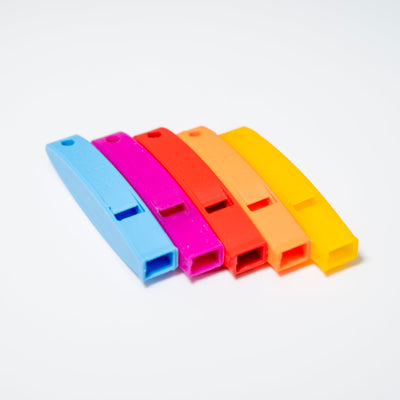
The story behind the creation and design of "3D Whistle 2g" (Part 2)


③Detailed design
We will adjust the previous conceptual design (plan and concept) with the feasible functions.
Cost, strength, and material selection are all judged here. This is a crucial step in checking whether there are any problems with the design for its function and concept.
The concept behind this whistle is "an ultra-lightweight, compact, loud, and easy-to-use whistle."
Because it's a small, simple item, it couldn't afford to have any performance aspects lacking, so we carefully revised the drawings and made improvements.
Actually, with v1, we studied monotonous pitches in a single engine room. Based on my experience in the brass band, I had the feeling that "it feels unpleasant when frequencies clash," so we changed to a two-engine room setup and pursued a sound that could be easily heard even in forests or mountains with wind noise.
The frequency range that the human ear can easily hear is 2000-4000Hz, so we set the target pitch as E7 2500[Hz] A=440[Hz].
Regarding volume, the speed and escape direction of the air are important, so we designed the cross-section to be curved like an airplane wing to increase the airflow velocity.
④ Production design
This is the final stage of the design process, where we verify that the design is optimized for production.
We planned to produce the product using a 3D printer, but the resin we initially chose was difficult to print and prone to warping, so we had to change the design.
With version 16, we created 52 different drawings, including minor changes. After repeating the process of creating more than 300 prototypes, the "3D Whistle 2g" was born.
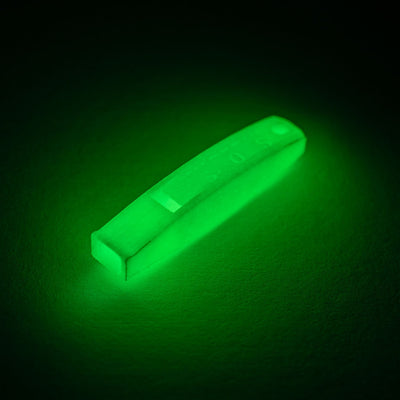
This year, we released "3D Whistle 2g with GLOW," which uses phosphorescent resin.
Available at outdoor equipment stores throughout Japan. Since it's useless if you don't have it on hand in an emergency, we produce with surplus stock in mind to prevent stockouts.